Farm and baby minutiae
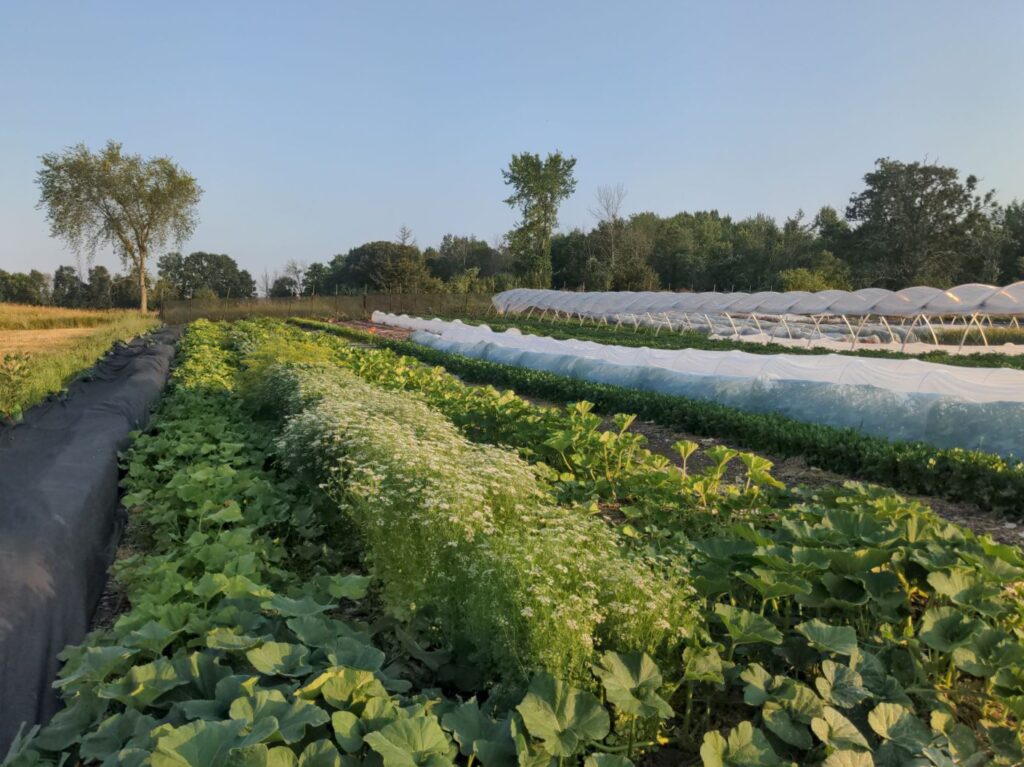
Back in 2022, I shared my then-new permanent garden bed system, detailing the transition process, and why I decided to pivot so drastically into a new mode of operation. Those new beds have now seen four growing seasons – each with wildly different weather events, from drought to flood to everything in between – and I’m happy to report that so far, they have been working wonderfully. Of course, with the farm settling into some semblance of regularity and rhythm, naturally, I thought, what better thing to do than to shake it all up again? Accordingly, I spent the 2023 growing season being very pregnant, and then subsequently in 2024 and 2025, being very mother-y.
And just like that, life on the farm changed again.
Full-time farming and full-time mother-ing do not mix well, because both are full-time jobs and one cannot be in two places at the same time. (I would like to think that this does not need saying, but based on some conversations I’ve had, maybe it does?!) No, I cannot strap my newborn to my back and go work in the garden, in 30°C and blazing sun and masses of deerflies and mosquitoes – conditions most full-grown adults would not care to spend time in. And no, when they’re older, I cannot work efficiently, while they “sit and play nearby”; in the same way you would never think to bring a toddler to an office and expect to get the same work output.
The thing is, there is a sort of romanticized aesthetic lure to the idea – it would be great if I could unlock the code to an equilibrium, where I solve for both motherhood and farming in some elegant synergistic way – or alternatively, figure out how to “work harder” and do both somehow. However unrealistic, the idea appeals to me because (as those who know me personally know well) I am very, very bad at moderation. I pull all-nighters binge-reading books, or I don’t read at all. There are either unopened bags of chips and candy in the house, or empty bags. I am completely subsumed by farmwork in the summer, but in the winter, I mutate into the most slovenly of sluggards. It is both a terrible and excellent trait to have as a farmer. On the one hand, pushing things (tools, my body, etc.) to the limit is actually helpful when you are trying to start a new farm business and gain some momentum. It’s also an awful tendency, because, obviously, pushing things to the limit all the time means breaking things sometimes (tools, my body, etc.). We have an ongoing joke-but-actually-it’s-kind-of-serious motto on the farm – “anything worth doing is worth overdoing” (Megan Whalen Turner, Thick as Thieves).
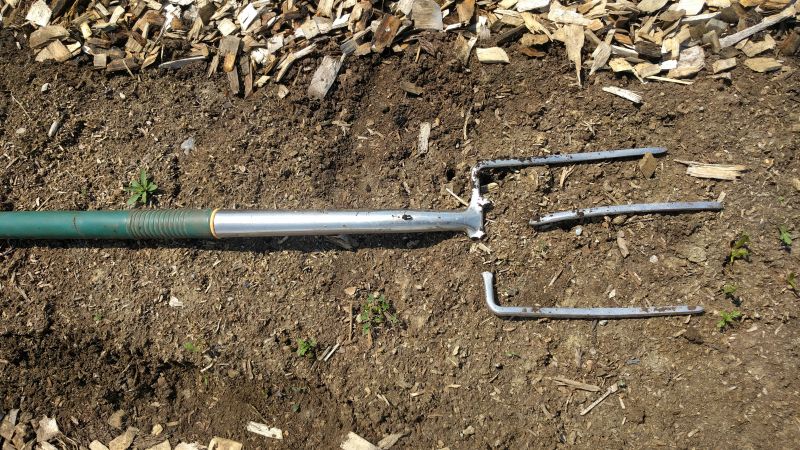
I knew, going into my first postpartum growing season in 2024, that I would have to exercise some serious restraint. I put a limit on the number of sign-ups for CSA, effectively halving my membership, and consequently, halving the amount of produce I’d be growing (and also halving my income, heh heh). I amended the farm motto to “anything worth doing is worth overdoing, including trying to get away with doing as little as possible”, and under this new vision, reassessed every single process and workflow on the farm that I could think of. My family and friends helped as often as they could – truly, the farm season could not have happened without them.
I also shifted the CSA season later by six weeks, running the season from late-July to late-November (instead of mid-June to mid-October). This might sound counterproductive, given our short growing season in Ontario, but this decision may have contributed almost as much to easing my workload as halving the CSA did (and without the loss of income). Where halving the CSA halved the crops that I had to grow but not the amount of work I had to do (economies of scale!), shifting the CSA season spread my workload out over time, allowing me to complete each task properly and on time, forestalling more complicated catch-up work down the line. A lot of additional work gets created by not getting to urgent tasks quickly enough – for example, a garden bed that takes ten minutes to weed in late spring could take several hours to weed if deferred for just one more week. And at certain times of the year, there just isn’t enough time to avoid this kind of cascading failure in task management.
I usually think of my busyness over the season as a curve that maps closely to the changing hours of daylight over the year – slow and sporadic in early February, peaking in the weeks before and after Summer Solstice, plateauing through the weeks of late summer, and gradually receding in the fall.
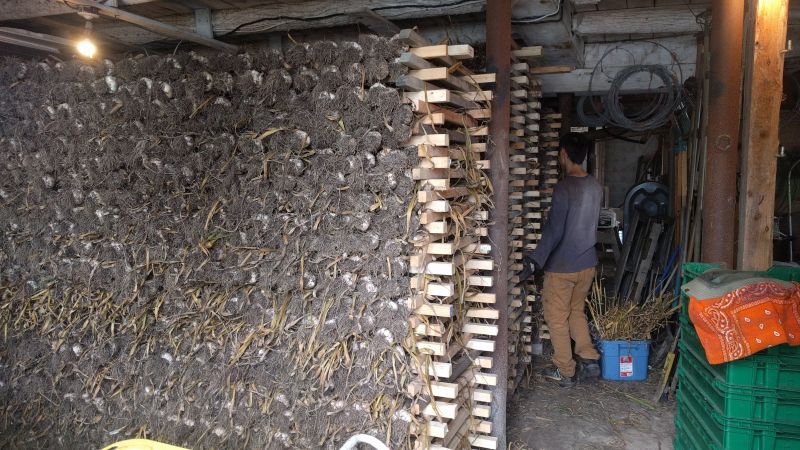
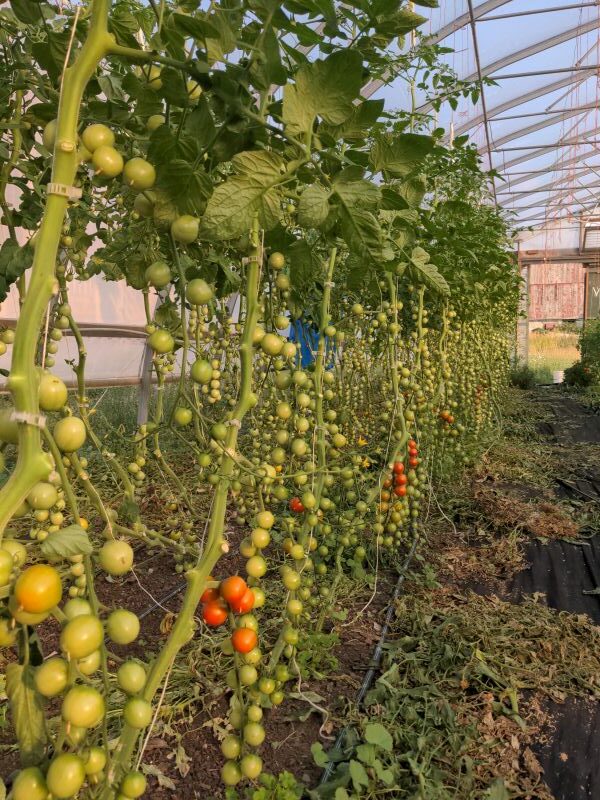
I have heard other growers joke about the July/August ban on contemplating quitting (unless you’re very sure you want to quit farming). July, in particular, is a tough month for a number of reasons. The plants that I planted back in the spring are growing at a frenetic rate, soaking in the long, long hours of sunlight. I am probably falling behind on trellising and pruning my tomatoes (they can grow >1ft a week), and this will slow me down when I go to harvest them and have to face a tangly jungle to do so – and catching up on the job after the fact takes much longer. But I can’t put in the time to trellis and prune when it matters most, because the plants I didn’t plant (weeds) are also growing at an equally frenetic pace. In fact, they are so much better adapted to being good at life, that they are usually growing faster than the plants that I did plant, and are well on their way to setting seed so that next year’s July will be even harder. I want to stay on top of weeding, but I don’t have the time because I’m not done seeding and planting yet. There are still fall crops that need to be started and if they are too delayed, I may as well not plant them at all because they probably won’t mature before it gets too cold. My storage alliums (like garlic and onions) are just reaching maturity, and I have to get them all out of the field and on drying racks before they rot. This is a big task because there are a lot of alliums – a whole year’s worth – needing attention in a few short days. July also means that the weather is also getting increasingly drier and hotter and insect populations are exploding. Plants and farmers alike are heat-stressed and itchy (farmer) or having holes bitten in their photosynthesizing surfaces (plants).
Over the years, I have put a lot of effort into smoothing the curve of work in July – trying to make each task as hyper-efficient as possible, playing with whatever timings I could control in order to spread tasks out more. But all my best efforts are essentially washed out once CSA begins in mid-June, and I have to actually get my produce to my customers. Apart from the actual growing of vegetables, a less recognized but equally large component of farming is harvesting, washing, sorting, packing, and transporting the produce to customers. Here on the farm, once CSA starts, that process takes three to four days out of each week, effectively halving the time I have to tend to the garden (and yes, a seven-day work week is assumed, see original farm motto!).
I think by now, it has become fairly obvious why delaying the CSA by six weeks made such a difference for me. For the entirety of July, when I am usually at my busiest, I had almost twice as much time to keep up with garden tasks. Instead of spending half the week on harvest/delivery, and then with the remaining time, conducting triage on a myriad of pressing tasks, I could comfortably stay on top of the planting schedule. I had the time to properly deal with weeds in their nascence before they bloomed into much bigger and time-consuming issues. I also gained an unexpected side effect from planting later in the season. All the insect pests (cucumber beetles, potato beetles, flea beetles, cabbage loopers, etc.) that emerged in late spring looking for some nice vegetables to munch on couldn’t find any of their host plants, and moved on. When I finally did plant my vegetables, the local populations of insect pests were much lower, and I didn’t have to spend as much time installing row cover and netting (a universally hated task – you try wrestling a hundred feet of flapping fabric in the wind!).
Shifting the CSA has been effective enough to allow me to keep farming after becoming a mother. But, looking further into the future, could this be the answer to how the farm will operate, at least until my baby gets older? I’m not entirely sure. There are definitely downsides to this strategy too. Starting the CSA late means ending the CSA late. We were incredibly fortunate in 2024 to have an abnormally warm and long fall. I was still harvesting and washing vegetables outdoors in the last week of November. November 2025 was an entirely different story, with the winter and snow coming early – harvesting and dragging produce through the snow in subzero temperatures was slow and brutal work. Additionally, I dislike the idea of having a six week delay in the spring before indulging in freshly harvested vegetables (I’m sure many of my CSA members would agree that the FOMO is real when other farmers start posting photos of beautiful spring greens and crunchy radishes).
More importantly, even with the surprisingly effective time-savings, even with the reduced CSA membership, even with all the generous help of my family and friends, I only just managed to make the last two farm seasons work. So, if you thought this would be a blog post about how I was able to gracefully land on a solution to balance growing a new human being and run a farm (and also find inner peace, etc.), well, you might have to look elsewhere.
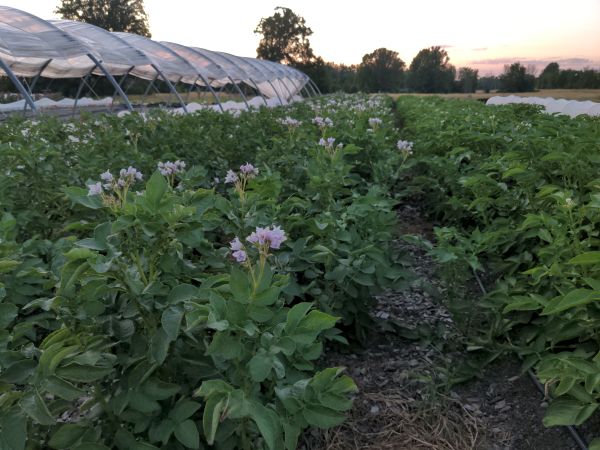
My current dilemma, although transitory (my baby will grow up into a more independent human eventually…right? RIGHT?), is really a subset of a bigger and ongoing reflection of where I see the farm business going.
At its most pared down form, I run a business where I grow vegetables that I sell for cash. How the vegetables are grown, who I sell them to and for how much cash – there are so many shapes this could take – is determined by the blending of the resources available to me, my ability to leverage those resources, and lastly, the extent to which I draw on my personal values to propel or limit the choices I make. There was probably a youthful time in my life when I hoped that what I did for a living would naturally and perfectly fall into alignment with my values. Small-scale vegetable farming was alluring to me for that very reason. On the surface, farming (and the shared narratives around it) seemed so morally exemplary, so uncomplicatedly wholesome.
Of course, once I actually started farming, I had to contend with real-world complexities. For all the claims out there of the many “best” ways to farm, things get decidedly ambiguous when you get into the nitty-gritty details. What is actually the most sustainable way to farm, and by what metric? Is it worse to use silage tarps to kill weeds (plastic!) or plow (soil biology disruption!)? Plug trays or soil blocks? I’m not running a non-profit, so to what extent do I acknowledge that I actually need to make some money doing this? Why is a small farm automatically more virtuous than a big farm, when resource input rates are sometimes higher on small farms because of the loss of economies of scale? Looking back, I think what I really wished for was to be absolved of the need to judge things for myself. I wanted a prescriptive solution; I didn’t want to have to do the tiresome work of wading through and examining the multitude of possibilities out there, and weighing them against my own ideals.
Adding a child to the mix has only made this deliberation more complicated. While pregnant, I was advised by many that “becoming a parent changes you” (and internally, I always thought, “um… of course? Given that this is a major life change, I would hope so?”). And while I found it cliché and unhelpfully vague as preparatory advice, now that I am on the other side of things (supposedly changed and all that), I have been reflecting on the quality of that change.
So far, as a first-time parent, I have noticed a paradoxical narrowing and widening of my perspective. The day-to-day, hour-to-hour act of being attuned to the needs of a single other living being is overwhelming and all-encompassing. And yet, my brain is also continuously and agonizingly aware of the space that this new human being now inhabits – from the farm and our creaky old farmhouse with all its potential discoveries and dangers (kitchen pots and puddles, so cool! Lead paint and ticks, not cool at all!), to the wider world, filled with so much wonder and ugliness and potential unraveling.
My sense of time is affected similarly. Having a child feels like being pressed more deeply, urgently, into both the present and the far-off future, all at the same time. This past summer, I lived and farmed under hazy skies and air choked with wildfire smoke, and even while I was weighing the relative benefits of taking my baby outdoors against the hour-to-hour air quality index value, the constant refrain in my head was, in thirty-some years, when my child is my age, will this be all they know?
Farm planning and strategizing has not been immune to my brain’s rewiring. These days, I think about the immediate present and the long-range future much more frequently than I do about the farm’s mid-range future (by the way, I’m pretty sure this is the exact opposite of what I should be doing as a business owner…). I turn over the day-to-day workings and needs of the farm, deconstructing them down to the smallest components and looking for any weaknesses or inefficiencies (to be fair, this may also be due to the aforementioned desperate need to make the most of the little time I have to actually farm, and the abundance of time for my mind to wander while tending to a baby in the middle of the night). Along with this distillation of the present comes a constant contemplation of the far-off future. I know I will always want to grow food for more than just myself. But what happens to the farm when (inevitably), my body starts to slow down? What is my succession plan? How far should I plan ahead when it comes to extreme weather? What will the bounds of “extreme” be in the future? Droughts are getting worse; what if, one year, it doesn’t rain for the whole season? (Apparently, this shouldn’t even be classed as a future-thought since this actually happened in 2025 and answer: we should probably dig another pond).
Not all my future-thoughts have been entirely apocalyptic in nature – I have an overflowing list of long-term projects that fall on the spectrum between half-completed and aspirational. I want to set up a proper weather station on the farm because the hyper-locality of weather events in our area makes regional weather forecasts infuriatingly inaccurate most of the time. I want to set up a bioacoustics bird monitoring program, mostly because birdsong is one of my many joys of working outdoors, but also because I’m a knowledge hoarder at heart and I want to know who sings and who doesn’t and when in the season, and I want to see whether this changes over time. I want to put better care into our half-neglected coppice stand (still somehow alive and growing, albeit slowly…maybe we’ll get firewood out of it when I’m an old lady?). I want to plant more hedgerows in our often-forgotten hayfield, and see how they affect local populations of birds and insects. I want to finish planting our windbreak treelines so that the persistent southwest wind that rockets down our neighbour’s huge hill will be softened by the time it hits the garden.
My long-term dream projects, by nature of being either perennial or not directly related to growing vegetables for cash, are also the ones that I end up setting aside in the crush and grind of an annual growing season. But most of them feature in what I hope the farm could look like far off in the future. In fact, some of them feel necessary for the survival of a farm business in the long-term. But for windbreaks, hedges, and historical data and trends to exist in that imagined future, most of them require that I act right now, as if I know that that future already exists. Present and future connected, not as a line, more an ouroboros.
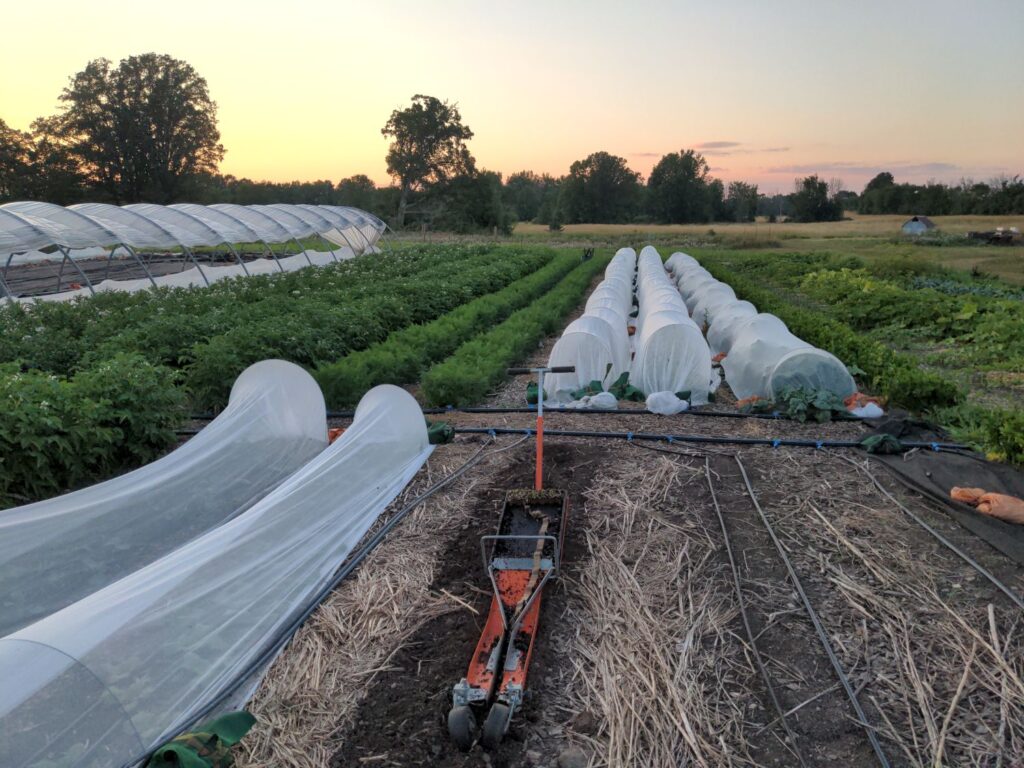
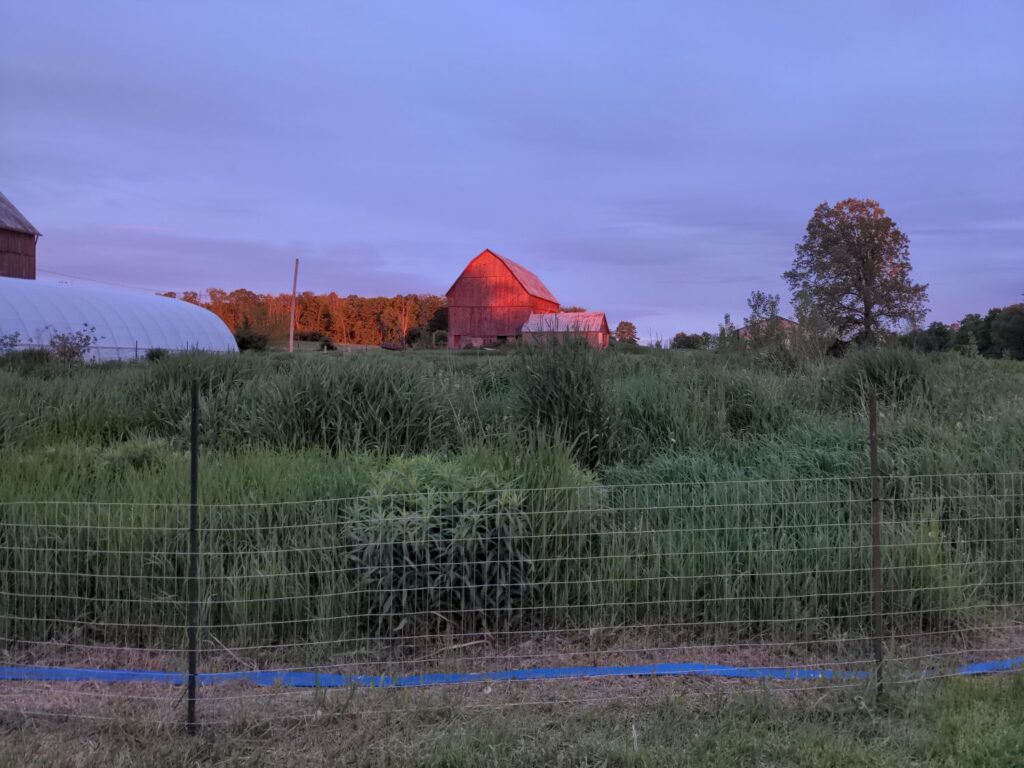
I’m writing this in early 2026, looking ahead at what will be a very different year. Because this time, unlike my first child who very conveniently arrived in the world at the end of the growing season, my second child will be here by summer, right in the middle of what would normally be my most busy weeks on the farm. This time, no amount of fiddly CSA rescheduling will get me around the immovable truth that I’m going to have to take the year off.
Well, kind-of.
I’m planning an early seedling sale that will hopefully end before my belly gets too big to bend over. And since I still plan to grow storage crops for myself, why not plant some extra in case anyone is interested in doing a storage crop CSA at the end of the year? And in any case, the garden still has to be maintained with a mixture of cover crops and tarping to prevent it from turning into a thistle jungle over the year. In whatever time I have left (which, despite an incoming newborn, would still be substantially more than what I would have in a normal growing season), I hope to shift some of those long-term projects from aspirational to real.
It feels odd to dwell so heavily on the present and far-off future, and yet to have all that time in between feel opaque. What happens after taking time off this year? Will I go back to the shifted CSA schedule, and will it work with two young children? And if it does work, how many years would I run the CSA on that schedule before I go back to normal? Can I go back to normal after? My reflexive response is to wish for a clear prescriptive solution to soothe my anxieties, a formula to ensure that the choices I make will allow both farm and children to flourish. And, if there is one maddening similarity between farming and parenting, it is the veritable deluge of messaging out there dispensing opinions and promising solutions, all with clear A-to-B narratives and an enviable aura of certainty. It does sound blissfully tranquil to believe one is making all the right choices; with a set course and time trajectory, I would only need to focus on working hard (see original farm motto) to move forward.
But in this off-kilter season of my life, when so little is certain and time feels like it has folded in on itself, I am finding that there are few “right” choices to be made; there are only choices that I hope I can live with, both now and later. Here, my farm motto fails. Instead, I hope to cultivate a sister tendency to lean hard into all things uncertain – if I’m going to have to do the arduous work of judging everything for myself, I may as well interrogate every corner of every possibility, wring out every last question there is to ask, layer each potential choice over both present and future, and see if the result is something I can live with.
♦
In the meantime, while I spend the better part of this coming year essentially taking overthinking to absurd levels, do stay tuned for any vegetable announcements. The garden might look very different this year but it won’t be completely bereft of food, and there will definitely be garlic (: